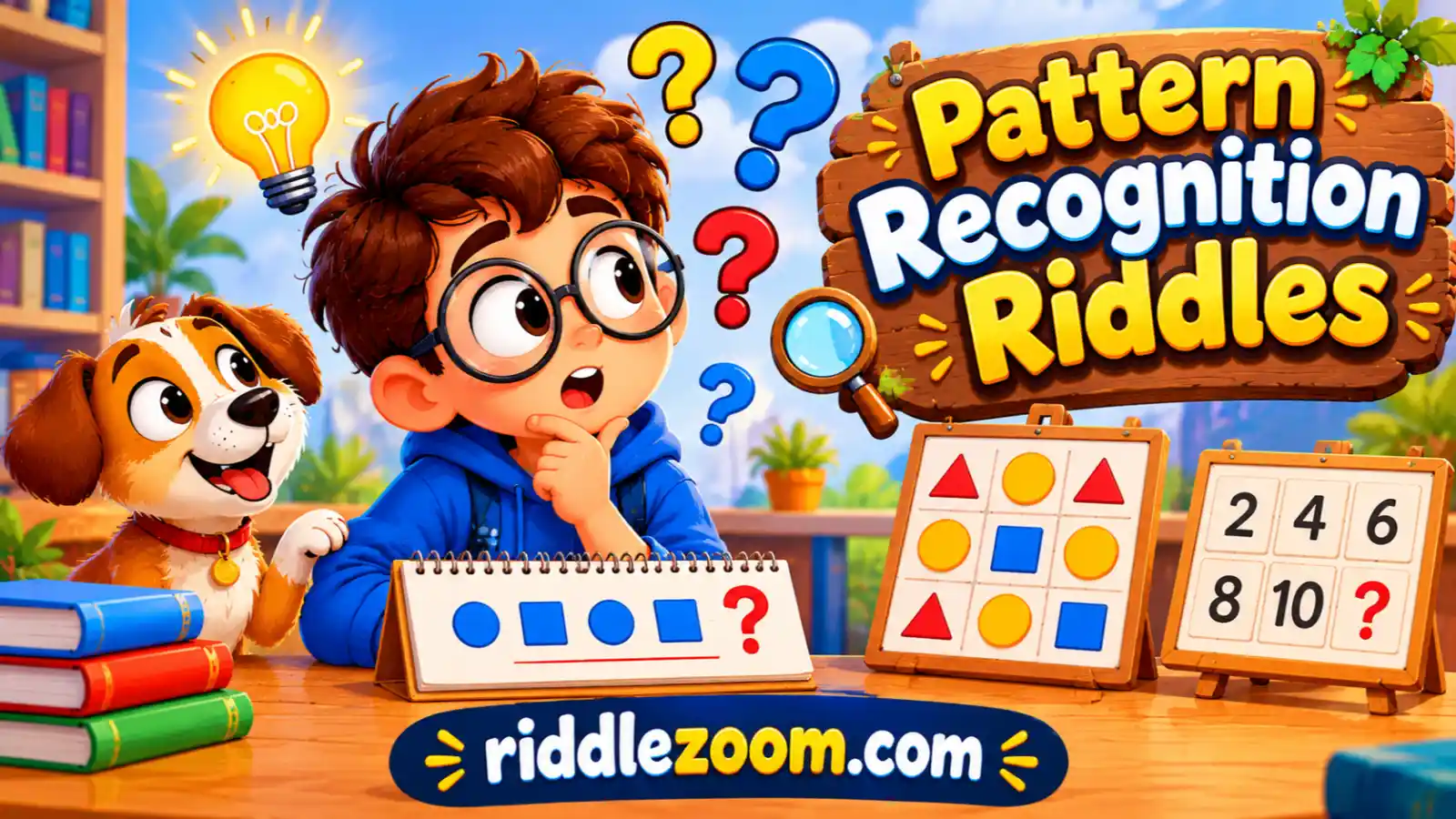
Patterns are hidden everywhere in the rhythm of raindrops, the arrangement of stars, the numbers on a page, and the colours of a rainbow.
Some patterns repeat in familiar ways, while others quietly change, waiting for a curious mind to discover their secret.
Pattern recognition riddles turn these everyday mysteries into playful challenges, inviting you to observe, compare, predict, and think beyond the obvious.
Whether you are a curious kid, a puzzle-loving teen, or an adult who enjoys a thoughtful brain workout, these riddles offer an entertaining way to explore how patterns work.
You will encounter number sequences, shape puzzles, letter arrangements, visual clues, and clever everyday challenges. Each puzzle gives you a chance to find what repeats, what changes, and what should come next.
The secret to solving pattern recognition riddles is to slow down and look for relationships. Does a number double? A shape rotate? Does a word lose a letter? A small detail can reveal the entire sequence.
💡 Did You Know?
- Pattern recognition is part of everyday thinking: People use patterns to recognise familiar faces, understand language, follow routines, and anticipate what may happen next. The brain constantly compares new information with what it has encountered before.
- Patterns can appear in many forms: They are not limited to numbers. Shapes, sounds, movements, colours, letters, and natural events can all follow repeating or changing arrangements.
Pattern recognition riddles make this ability playful. They encourage you to look for connections, test possible rules, and decide whether a sequence follows a consistent pattern.
🎯 Riddle of the Day: The Secret Garden Sequence
In a garden, three flowers bloom,
A silver star begins to loom.
One flower fades, two stars appear,
Then three green leaves quietly draw near.
The garden changes in a secret way,
What will the next visitor see today?
Can you discover the hidden pattern? Share your answer and explain your reasoning in the comments. Sometimes the best solution comes from noticing what changes—not just what stays the same.
1. Easy Pattern Recognition Riddles for Beginners
Start your pattern journey with these simple puzzles. Look for repeated numbers, familiar objects, and small changes that reveal what comes next.
- Riddle 1: Two, four, six, eight march in a line,
Each number grows by the same design.
What number comes next?
Answer: Ten - Riddle 2: Red, blue, red, blue appear,
The colours take turns year after year.
Which colour comes next?
Answer: Red - Riddle 3: One star shines, then two stars glow,
Three stars follow in a row.
How many shine in the next group?
Answer: Four stars - Riddle 4: Monday, Tuesday, Wednesday appear,
Each day brings another step near.
Which day follows Wednesday?
Answer: Thursday - Riddle 5: A circle, a square, a circle, a square,
The same two shapes take turns with care.
What shape comes next?
Answer: A circle - Riddle 6: Five, ten, fifteen, twenty are shown,
The same amount is added as they are grown.
What number follows?
Answer: Twenty-five - Riddle 7: A small, medium, large pattern repeats,
Three different sizes take their seats.
What comes after large?
Answer: Small - Riddle 8: A, B, C, D begin the song,
The alphabet carries the sequence along.
Which letter comes next?
Answer: E - Riddle 9: One, three, five, seven are odd,
Each number follows the same mathematical road.
What comes next?
Answer: Nine - Riddle 10: A clap, a tap, a clap, a tap,
The rhythm repeats without a gap.
What sound comes next?
Answer: A clap - Riddle 11: January, March, May appear,
Every second month brings the year.
Which month comes next in this sequence?
Answer: July - Riddle 12: A triangle has three sides to show,
A square has four in its familiar row.
A pentagon has five; what comes next?
Answer: A hexagon - Riddle 13: One leaf, two leaves, three leaves grow,
Each new picture adds one more to show.
How many leaves come next?
Answer: Four leaves - Riddle 14: North, east, south, west appear,
Four directions complete the circle here.
Which direction begins the cycle again?
Answer: North - Riddle 15: A bell rings once, then twice, then thrice,
Each turn adds one to the sound’s device.
How many rings come next?
Answer: Four rings
2. Number Pattern Riddles to Challenge Your Logic
Number sequences are among the most familiar pattern puzzles. Search for addition, subtraction, multiplication, division, or another mathematical relationship.
- Riddle 1: Three, six, nine, twelve take their place,
Three is added at a steady pace.
What number comes next?
Answer: Fifteen - Riddle 2: One, two, four, eight appear,
Each number doubles as it draws near.
What follows eight?
Answer: Sixteen - Riddle 3: Fifty, forty, thirty, twenty descend,
Ten disappears with every bend.
What comes next?
Answer: Ten - Riddle 4: Two, five, eight, eleven climb,
Three is added every time.
What number follows?
Answer: Fourteen - Riddle 5: One, four, nine, sixteen are seen,
Their square-number pattern stays neat and clean.
What comes next?
Answer: Twenty-five - Riddle 6: One, three, six, ten appear,
Each step adds one more than the year before.
What is the next number?
Answer: Fifteen - Riddle 7: One hundred, fifty, twenty-five,
Each number is halved to keep the pattern alive.
What comes next?
Answer: Twelve and a half - Riddle 8: Two, six, twelve, twenty are displayed,
The gaps grow by two as the numbers are made.
What comes next?
Answer: Thirty - Riddle 9: One, eight, twenty-seven, sixty-four are in line,
Each is a cube made by a number’s design.
What comes next?
Answer: One hundred and twenty-five - Riddle 10: Ninety, eighty, seventy, sixty fall,
Ten is removed from each number in all.
What comes next?
Answer: Fifty - Riddle 11: Four, eight, sixteen, thirty-two rise,
Each number doubles before your eyes.
What follows thirty-two?
Answer: Sixty-four - Riddle 12: One, four, seven, ten are shown,
Three is added as the sequence is grown.
What comes next?
Answer: Thirteen - Riddle 13: Two, three, five, seven appear,
Prime numbers are gathered here.
What is the next prime number?
Answer: Eleven - Riddle 14: One, two, six, twenty-four take flight,
Each term multiplies by the next whole number in sight.
What comes next?
Answer: One hundred and twenty - Riddle 15: One, one, two, three, five, eight are shown,
Each new term adds the two before it as it is grown.
What comes next?
Answer: Thirteen
3. Shape Pattern Riddles for Visual Thinkers
Shapes can repeat, rotate, grow, or change their positions. Imagine each arrangement carefully and look for the rule connecting one figure to the next.
- Riddle 1: Circle, square, triangle appear,
Then the same three shapes return.
Which shape follows the triangle?
Answer: Circle - Riddle 2: A triangle points upward,
Then downward, then upward once more.
Which way should the next triangle point?
Answer: Downward - Riddle 3: One square becomes two, then three,
Each picture adds another to the scene.
How many squares come next?
Answer: Four squares - Riddle 4: A circle turns a quarter round,
Then another quarter brings it around.
After a half-turn, how many degrees has it rotated?
Answer: One hundred and eighty degrees - Riddle 5: A small triangle, a medium triangle,
A large triangle follows the same trail.
What size should come next?
Answer: Small - Riddle 6: One dot sits alone in a square,
Two dots appear in the next with care.
Three dots follow; how many come next?
Answer: Four dots - Riddle 7: A star has five points to display,
A hexagon has six along its way.
Which shape has seven sides?
Answer: A heptagon - Riddle 8: A line moves left, then right, then left,
The direction alternates with every step.
Which way does the next line move?
Answer: Right - Riddle 9: One small circle sits inside a square,
Two circles appear in the next design there.
How many circles should the third design contain?
Answer: Three circles - Riddle 10: A square turns ninety degrees,
Then turns another ninety with ease.
How many degrees has it turned altogether?
Answer: One hundred and eighty degrees - Riddle 11: Triangle, pentagon, heptagon appear,
Each shape gains two sides as they draw near.
Which polygon comes next?
Answer: A nonagon - Riddle 12: A row has one square, then a pair,
Then three squares standing there.
How many should the next row contain?
Answer: Four squares - Riddle 13: A dot moves from the top to the right,
Then to the bottom, following the light.
Where does it move next?
Answer: To the left - Riddle 14: A small circle grows into a medium one,
Then a large circle completes the run.
What size comes after large in a repeating pattern?
Answer: Small - Riddle 15: A diamond, a diamond, a star appear,
Two diamonds are followed by one star here.
Which shape comes next?
Answer: A diamond
4. Alphabet and Letter Pattern Riddles
Letters can follow alphabetical order, skip positions, repeat in groups, or change according to a simple rule. These puzzles test your ability to spot those hidden arrangements.
- Riddle 1: A, C, E, G move along,
Every second letter joins the song.
Which letter comes next?
Answer: I - Riddle 2: B, D, F, H appear in a row,
Two alphabet steps make the pattern grow.
Which letter follows?
Answer: J - Riddle 3: Z, Y, X, W descend,
The alphabet runs backward to the end.
Which letter comes next?
Answer: V - Riddle 4: A, B, D, G, K are seen,
The gaps grow by one each time between.
Which letter follows?
Answer: P - Riddle 5: C, F, I, L appear,
Three alphabet steps bring each one near.
What letter comes next?
Answer: O - Riddle 6: A, E, I, O are displayed,
The vowels take their familiar parade.
Which vowel completes the sequence?
Answer: U - Riddle 7: M, N, O, P move ahead,
Four letters in order have been read.
What letter comes next?
Answer: Q - Riddle 8: A, Z, B, Y, C, X are paired,
One letter moves forward while another moves backward.
What comes next?
Answer: D - Riddle 9: AA, BB, CC, DD appear,
Matching letters make the pattern clear.
Which pair follows?
Answer: EE - Riddle 10: A, D, G, J take their place,
Three letters ahead is the steady pace.
What comes next?
Answer: M - Riddle 11: F, E, D, C go back,
The alphabet follows a reverse track.
Which letter comes next?
Answer: B - Riddle 12: AB, CD, EF, GH are shown,
Consecutive pairs are neatly grown.
Which pair follows?
Answer: IJ - Riddle 13: A, C, F, J, O appear,
The jumps increase by one each year.
Which letter comes next?
Answer: U - Riddle 14: B, E, H, K appear in line,
Three positions forward each time.
What comes next?
Answer: N - Riddle 15: Q, R, S, T are read,
Four neighbours have been led.
Which letter follows T?
Answer: U
5. Colour Pattern Riddles for Sharp Observation
Colour patterns often rely on repetition or a changing sequence. Watch for alternating colours, growing groups, and arrangements that repeat after a fixed number of steps.
- Riddle 1: Red, yellow, blue, red, yellow, blue,
The same three colours return to view.
What colour comes next?
Answer: Red - Riddle 2: Green, green, orange, green, green, orange,
The three-colour rhythm continues on.
What comes next?
Answer: Green - Riddle 3: Black, white, black, white,
Two colours alternate left and right.
What colour follows?
Answer: Black - Riddle 4: Purple, pink, pink, purple, pink, pink,
The colour groups repeat in sync.
What comes next?
Answer: Purple - Riddle 5: One red dot, two blue dots,
Three green dots fill their spots.
What colour belongs to the next group?
Answer: Yellow - Riddle 6: Light blue, dark blue, light blue, dark blue,
The shades take turns in the view.
What shade comes next?
Answer: Light blue - Riddle 7: Yellow, orange, red appear,
The colours grow warmer as they draw near.
Which colour could continue the warm sequence?
Answer: Red-orange - Riddle 8: A red square, a blue circle,
A red square, a blue circle.
Which figure comes next?
Answer: A red square - Riddle 9: White, grey, black, white, grey, black,
Three shades repeat along the track.
What colour follows?
Answer: White - Riddle 10: A green leaf, a yellow leaf,
A brown leaf completes the autumn scene.
Which colour begins the cycle again?
Answer: Green - Riddle 11: Pink, pink, blue, pink, pink, blue,
The same colour group comes into view.
What colour follows?
Answer: Pink - Riddle 12: Red becomes orange, orange becomes yellow,
The colour shifts like a glowing fellow.
What colour could follow in a simple warm gradient?
Answer: Green - Riddle 13: A blue bead, a blue bead, a gold bead,
The same three-bead group repeats indeed.
What colour comes next?
Answer: Blue - Riddle 14: Silver, gold, bronze appear,
The medals follow a familiar order here.
Which medal colour completes the sequence?
Answer: Silver - Riddle 15: A yellow star, a green star, a red star,
The colours repeat no matter how far.
Which colour comes after red?
Answer: Yellow
6. Shape and Number Combination Riddles
Some puzzles combine two different kinds of patterns. You may need to count sides, connect numbers to shapes, or notice how both parts change together.
- Riddle 1: A triangle holds the number three,
A square holds four for you to see.
What number belongs inside a pentagon?
Answer: Five - Riddle 2: One circle has one dot,
Two squares have two dots in their spot.
Three triangles have how many dots?
Answer: Three dots on each triangle, if the pattern assigns one dot per shape - Riddle 3: A triangle has three sides and three corners,
A square has four sides and four corners.
How many corners does a hexagon have?
Answer: Six - Riddle 4: One square is worth four,
Two squares are worth eight in total.
What are three squares worth?
Answer: Twelve - Riddle 5: A pentagon has five sides,
A hexagon has six beside it.
What is the side count of an octagon?
Answer: Eight - Riddle 6: One triangle, two squares, three pentagons appear,
The shape’s side count increases each year.
Which polygon follows the pentagon?
Answer: A hexagon - Riddle 7: A circle is worth zero corners,
A triangle is worth three, and a square four.
How many corners does a heptagon have?
Answer: Seven - Riddle 8: One cube has six faces,
Two cubes have twelve in their places.
How many faces do four cubes have altogether?
Answer: Twenty-four - Riddle 9: A triangle carries one star,
A square carries two from afar.
A pentagon carries three; how many stars does a hexagon carry?
Answer: Four stars - Riddle 10: Three sides make a triangle,
Four sides make a square.
How many sides belong to a decagon?
Answer: Ten - Riddle 11: A shape’s number is its side count,
A triangle gives three, a hexagon gives six.
What number belongs to a nonagon?
Answer: Nine - Riddle 12: One square is followed by one triangle,
Two squares are followed by two triangles.
What comes after three squares?
Answer: Three triangles - Riddle 13: A cube has eight corners,
A cuboid has eight as well.
How many corners does a pyramid with a square base have?
Answer: Five - Riddle 14: One pentagon has five sides,
Two pentagons have ten sides altogether.
How many sides do three pentagons have altogether?
Answer: Fifteen - Riddle 15: A triangle’s sides add to three,
A square’s sides add to four.
What is the total number of sides in a triangle and a hexagon together?
Answer: Nine
7. Repeating Pattern Riddles for Quick Thinkers
Repeating patterns return to an earlier arrangement after a set number of steps. Find the length of the repeating group, then predict what appears next.
- Riddle 1: Cat, dog, bird, cat, dog, bird,
Three familiar names are heard.
Which animal comes next?
Answer: Cat - Riddle 2: Clap, clap, tap, clap, clap, tap,
The rhythm repeats without a gap.
What sound comes next?
Answer: Clap - Riddle 3: One, two, one, two, one, two,
The same pair returns to view.
What number follows?
Answer: One - Riddle 4: Star, moon, sun, star, moon, sun,
The sky’s small pattern has begun.
What comes next?
Answer: Star - Riddle 5: Up, down, left, up, down, left,
The same directions are never left.
Which direction comes next?
Answer: Up - Riddle 6: A, B, B, A, B, B,
The letter group repeats for you and me.
What comes next?
Answer: A - Riddle 7: Red, red, blue, yellow, red, red, blue, yellow,
Four colours repeat in a cheerful fellow.
What comes next?
Answer: Red - Riddle 8: One step forward, one step back,
One step forward, one step back.
Which movement follows?
Answer: One step forward - Riddle 9: Circle, circle, square, circle, circle, square,
The same group appears everywhere.
What shape comes next?
Answer: Circle - Riddle 10: Morning, noon, night, morning, noon, night,
Three parts of the day repeat in sight.
What comes next?
Answer: Morning - Riddle 11: Tick, tock, tock, tick, tock, tock,
The rhythm sounds like a clock.
What comes next?
Answer: Tick - Riddle 12: Small, large, medium, small, large, medium,
Three sizes return in a steady stream.
What comes next?
Answer: Small - Riddle 13: North, south, north, south, north, south,
Two directions move from mouth to mouth.
What follows?
Answer: North - Riddle 14: One dot, two dots, three dots, one dot, two dots, three dots,
The same little group fills its spots.
How many dots come next?
Answer: One dot - Riddle 15: Smile, frown, smile, frown,
Two expressions pass around.
Which expression comes next?
Answer: Smile
8. Increasing and Decreasing Pattern Riddles
In these puzzles, something grows or shrinks with each step. Watch the difference between one term and the next to discover the hidden rule.
- Riddle 1: One, three, six, ten rise,
The gaps grow larger before your eyes.
What number comes next?
Answer: Fifteen - Riddle 2: Forty, thirty-five, thirty, twenty-five descend,
Five disappears around each bend.
What comes next?
Answer: Twenty - Riddle 3: One, two, four, seven, eleven climb,
The gaps increase by one each time.
What follows?
Answer: Sixteen - Riddle 4: One hundred, ninety, seventy, forty,
The drops grow by ten each time.
What comes next?
Answer: Zero - Riddle 5: Two, five, nine, fourteen, twenty,
Each jump grows by one in this sequence.
What is next?
Answer: Twenty-seven - Riddle 6: One, four, eight, thirteen, nineteen,
The rising gaps make a pattern unseen.
What comes next?
Answer: Twenty-six - Riddle 7: Sixty-four, thirty-two, sixteen, eight,
Each number is halved as you calculate.
What follows?
Answer: Four - Riddle 8: Five, ten, twenty, forty, eighty,
Each number doubles quickly.
What comes next?
Answer: One hundred and sixty - Riddle 9: One, four, nine, sixteen, twenty-five,
The square numbers keep the sequence alive.
What comes next?
Answer: Thirty-six - Riddle 10: Fifty-five, forty-five, thirty-five, twenty-five,
Ten is removed to keep the pattern alive.
What comes next?
Answer: Fifteen - Riddle 11: Three, seven, twelve, eighteen, twenty-five,
Each gap grows by one as the numbers climb.
What follows?
Answer: Thirty-three - Riddle 12: One, three, nine, twenty-seven,
Each number is multiplied by three.
What comes next?
Answer: Eighty-one - Riddle 13: Eighty-one, twenty-seven, nine, three,
Each number is divided by three.
What follows?
Answer: One - Riddle 14: Two, four, seven, eleven, sixteen,
The gaps grow by one between each scene.
What comes next?
Answer: Twenty-two - Riddle 15: One, five, thirteen, twenty-nine, sixty-one,
Double each number and add three to get the next one.
What follows?
Answer: One hundred and twenty-five
9. Nature-Inspired Pattern Recognition Riddles
Nature offers repeating shapes, seasonal cycles, and changing sequences. These riddles invite you to notice how patterns appear in the world around us.
- Riddle 1: Spring brings blossoms, summer brings fruit,
Autumn drops leaves, winter rests at the root.
Which season begins the cycle again?
Answer: Spring - Riddle 2: A butterfly begins as an egg,
Then a caterpillar moves on many legs.
What stage comes after the caterpillar?
Answer: The chrysalis or pupa - Riddle 3: New moon, first quarter, full moon appear,
The lunar cycle keeps turning each month.
Which phase follows the full moon?
Answer: The waning gibbous phase - Riddle 4: Dawn arrives, the sun climbs high,
Then dusk brings colours to the sky.
What comes after dusk?
Answer: Night - Riddle 5: A seed becomes a sprout,
A stem and leaves begin to come out.
What may develop next?
Answer: A mature plant - Riddle 6: A river flows from hills to plains,
It joins a larger body as it gains.
What may the river reach at the end?
Answer: A sea - Riddle 7: Rain falls, water gathers,
Sunlight warms the puddles and vapour rises.
What stage of the water cycle is this?
Answer: Evaporation - Riddle 8: A tree grows rings year by year,
Each ring records another growing season here.
What do the rings help reveal?
Answer: The tree’s age and growing conditions - Riddle 9: A spider spins a web in a repeated design,
Radial threads and spiral lines combine.
What animal creates this pattern?
Answer: A spider - Riddle 10: A flower opens with the morning light,
Then closes as evening approaches the night.
What kind of natural pattern is this?
Answer: A daily rhythm - Riddle 11: The tide rises, the tide falls,
The sea repeats its watery calls.
What causes most ocean tides?
Answer: The gravitational pull of the Moon and Sun - Riddle 12: A snowflake grows with six-fold design,
Its branches form a delicate line.
What is its common shape pattern?
Answer: Six-sided symmetry - Riddle 13: A bee visits flower after flower,
Collecting nectar hour after hour.
What useful process does it help along?
Answer: Pollination - Riddle 14: The Earth spins and sunlight moves,
Day and night follow familiar grooves.
What causes this repeating cycle?
Answer: Earth’s rotation - Riddle 15: A bird builds a nest, lays eggs,
Then raises young with careful care.
What recurring natural process is described?
Answer: A bird’s breeding and nesting cycle
10. Word and Language Pattern Riddles
Words can form patterns through spelling, syllables, letter positions, and repeated sounds. Read each clue closely and look at how the words are built.
- Riddle 1: CAT becomes CATS with one letter more,
DOG becomes DOGS by the same little door.
What happens to BOOK?
Answer: BOOK becomes BOOKS - Riddle 2: I am a word that reads the same,
From front to back, I keep my name.
What word am I: level, table, or garden?
Answer: Level - Riddle 3: Add one letter to “at” to make a place,
Where a person might sit with a book in their space.
What word can you make?
Answer: Mat - Riddle 4: SUN becomes SUNSHINE,
RAIN becomes RAINBOW in a similar line.
What can SNOW become in a compound word?
Answer: Snowfall - Riddle 5: One syllable in “cat,” two in “kitten,”
Three in “beautiful,” if carefully written.
How many syllables are in “banana”?
Answer: Three - Riddle 6: Take the first letter of apple,
The second of bear, and the third of cat.
What letters do you get?
Answer: A, E, and T - Riddle 7: I begin with B and end with K,
I hold many stories along the way.
What word am I?
Answer: Book - Riddle 8: If “care” becomes “careful,”
And “hope” becomes “hopeful,”
What does “use” become?
Answer: Useful - Riddle 9: Add “un” before “kind,”
A new opposite word you will find.
What is it?
Answer: Unkind - Riddle 10: One letter begins “sun,”
The same letter starts “star” and “sky.”
Which letter appears in all three beginnings?
Answer: S - Riddle 11: Take the final letter from “rain,”
The final letter from “snow,”
And the final letter from “wind.”
What letters do you get?
Answer: N, W, and D - Riddle 12: If “play” becomes “player,”
And “teach” becomes “teacher,”
What does “write” become?
Answer: Writer - Riddle 13: I am a word with five letters,
Remove my first and I still sound the same.
What word could I be?
Answer: Queue - Riddle 14: Each word in this group has a silent letter:
Knife, knee, and know.
Which letter is silent in all three?
Answer: K - Riddle 15: Start with “light,” add “house” at the end,
A new word helps ships around a bend.
What word is formed?
Answer: Lighthouse
11. Advanced Pattern Recognition Riddles for Adults
These puzzles require you to combine clues, identify less obvious rules, and distinguish a likely pattern from one that is mathematically guaranteed.
- Riddle 1: Two, three, five, eight, twelve, seventeen appear,
Each gap grows by one as the numbers draw near.
What comes next?
Answer: Twenty-three - Riddle 2: One, two, six, twenty-four, one hundred and twenty,
Each term is multiplied by the next counting number.
What follows?
Answer: Seven hundred and twenty - Riddle 3: Three, six, eleven, eighteen, twenty-seven,
The gaps are three, five, seven, and nine.
What comes next?
Answer: Thirty-eight - Riddle 4: One, four, ten, twenty, thirty-five,
The sequence adds triangular numbers as it climbs.
What comes next?
Answer: Fifty-six - Riddle 5: Two, six, twelve, twenty, thirty,
Each term is a product of neighbouring whole numbers.
What comes next?
Answer: Forty-two - Riddle 6: One, eight, twenty-seven, sixty-four, one hundred and twenty-five,
Each term is a whole number raised to the third power.
What comes next?
Answer: Two hundred and sixteen - Riddle 7: One, two, four, seven, eleven, sixteen,
The difference grows by one each time.
What is the next number?
Answer: Twenty-two - Riddle 8: One, eleven, twenty-one, one hundred and twenty-one,
Each term describes the digits in the previous term.
What comes next?
Answer: One thousand, one hundred and eleven - Riddle 9: Ten, eleven, one hundred, one hundred and one,
Read the numbers as a pattern of digits in binary-like steps.
What is the next number if the sequence is powers of two written in binary?
Answer: One thousand - Riddle 10: One, four, nine, sixteen, twenty-five, thirty-six,
Each number is a perfect square.
What is the seventh term?
Answer: Forty-nine - Riddle 11: Two, three, five, seven, eleven, thirteen,
Every term is prime.
What is the next prime number?
Answer: Seventeen - Riddle 12: One, two, six, twenty-four, one hundred and twenty,
The factorial pattern continues.
What is the next term?
Answer: Seven hundred and twenty - Riddle 13: One, four, thirteen, forty, one hundred and twenty-one,
Multiply by three and add one each time.
What comes next?
Answer: Three hundred and sixty-four - Riddle 14: One, five, fourteen, thirty, fifty-five,
The gaps are four, nine, sixteen, and twenty-five.
What follows?
Answer: Ninety-one - Riddle 15: Two, twelve, thirty-six, eighty, one hundred and fifty,
Each term is the product of a number and its square.
What is the next term?
Answer: Two hundred and fifty-two
12. Tricky Mixed Pattern Riddles for Curious Minds
These mixed puzzles combine letters, numbers, directions, and everyday clues. Some sequences can have more than one possible continuation unless the rule is stated, so use the most consistent pattern suggested.
- Riddle 1: A1, B2, C3, D4 appear,
Each letter is paired with its alphabet position.
What comes next?
Answer: E5 - Riddle 2: Monday 1, Tuesday 2, Wednesday 3,
Each day is paired with its position in the week.
What follows Thursday?
Answer: Friday 5 - Riddle 3: 1A, 2B, 3C, 4D are shown,
The number rises as the letter moves along.
What comes next?
Answer: 5E - Riddle 4: North 1, East 2, South 3, West 4,
The directions are numbered in clockwise order.
What comes next if the cycle repeats?
Answer: North 1 - Riddle 5: 2A, 4B, 6C, 8D appear,
Even numbers pair with letters in order.
What comes next?
Answer: 10E - Riddle 6: One sun, two moons, three stars,
Four clouds appear beyond the bars.
What comes next if the object count rises by one?
Answer: Five rainbows - Riddle 7: A1, C3, E5, G7 are seen,
Both letter and number advance by two.
What comes next?
Answer: I9 - Riddle 8: 10, A, 20, B, 30, C,
Numbers rise by ten while letters move forward.
What comes next?
Answer: 40 - Riddle 9: January, February, March, April,
Each month moves one place through the calendar.
What comes next?
Answer: May - Riddle 10: 1 red, 2 blue, 3 green, 4 yellow,
Each number increases while the colours change.
What is the next number in the sequence?
Answer: Five - Riddle 11: A1, B2, C4, D8 appear,
Letters move one step while numbers double.
What comes next?
Answer: E16 - Riddle 12: 1 circle, 2 squares, 3 triangles,
4 rectangles follow in a row.
How many shapes belong to the next group?
Answer: Five shapes - Riddle 13: 2, A, 4, B, 6, C, 8, D,
Even numbers alternate with letters in order.
What comes next?
Answer: 10 - Riddle 14: First, second, third, fourth,
Ordinal words mark each position.
Which word follows fourth?
Answer: Fifth - Riddle 15: A1, B4, C9, D16,
Letters advance while numbers are perfect squares.
What comes next?
Answer: E25
13. Final Brain-Teasing Pattern Recognition Riddles
Ready for one last challenge? These final puzzles bring together number rules, repeated groups, and clever observations. Take your time and enjoy finding the hidden order.
- Riddle 1: Three, five, nine, seventeen, thirty-three,
Each number doubles and loses one.
What comes next?
Answer: Sixty-five - Riddle 2: One, two, five, ten, seventeen,
The gaps grow by two each time.
What comes next?
Answer: Twenty-six - Riddle 3: Four, nine, sixteen, twenty-five, thirty-six,
The square numbers climb in a steady mix.
What follows?
Answer: Forty-nine - Riddle 4: One, three, seven, fifteen, thirty-one,
Each term doubles and adds one.
What comes next?
Answer: Sixty-three - Riddle 5: Two, five, ten, seventeen, twenty-six,
Each term is one more than a square number.
What comes next?
Answer: Thirty-seven - Riddle 6: One, four, thirteen, forty, one hundred and twenty-one,
Multiply by three and add one to continue.
What follows?
Answer: Three hundred and sixty-four - Riddle 7: A, C, F, J, O,
The alphabet jumps by one more each time.
Which letter comes next?
Answer: U - Riddle 8: One, one, two, three, five, eight, thirteen,
Each new number combines the two before it.
What comes next?
Answer: Twenty-one - Riddle 9: Ninety-six, forty-eight, twenty-four, twelve,
Each number is divided by two.
What comes next?
Answer: Six - Riddle 10: One, eight, twenty-seven, sixty-four,
The cubes follow a rising mathematical road.
What is the next number?
Answer: One hundred and twenty-five - Riddle 11: Two, six, twelve, twenty, thirty,
Multiply each whole number by the next one.
What comes next?
Answer: Forty-two - Riddle 12: One, four, nine, sixteen, twenty-five,
The square pattern keeps the sequence alive.
What is the eighth term?
Answer: Sixty-four - Riddle 13: One, three, six, ten, fifteen,
The triangular numbers grow between.
What comes next?
Answer: Twenty-one - Riddle 14: Five, ten, twenty, forty, eighty,
Each number doubles in a hurry.
What comes after eighty?
Answer: One hundred and sixty - Riddle 15: One, two, six, twenty-four, one hundred and twenty,
The factorial sequence is nearly complete.
What comes next?
Answer: Seven hundred and twenty
FAQs:
1. What are pattern recognition riddles?
Pattern recognition riddles are puzzles that ask you to identify a repeated arrangement, sequence, or relationship and use it to predict what comes next. They may involve numbers, letters, shapes, colours, sounds, or everyday objects.
2. How do you solve pattern recognition riddles?
Start by comparing the first few items. Check whether numbers are added, subtracted, multiplied, or divided. For shapes and colours, look for repetition, rotation, position changes, or increasing groups. Test your suspected rule against every item before choosing an answer.
3. What skills do pattern recognition puzzles develop?
These puzzles provide practice in observation, logical thinking, comparison, sequencing, and problem-solving. They also encourage flexible thinking because a pattern may be based on numbers, visual features, language, or more than one rule.
4. Are pattern recognition riddles suitable for kids?
Yes. Simple colour, shape, and number sequences can be enjoyable for children and support early learning. Choose puzzles that match the child’s age and experience, then gradually introduce more complex patterns as their confidence grows.
5. What is the difference between a number pattern and a visual pattern?
A number pattern uses numerical relationships, such as adding five or doubling each term. A visual pattern uses features such as shape, colour, size, direction, or position. Both involve finding a rule and using it to predict what comes next.
Conclusion:
Pattern recognition riddles turn small details into exciting discoveries. A simple number sequence can reveal a mathematical rule, a changing shape can uncover a rotation, and a repeated colour arrangement can challenge your observation.
Every puzzle gives you an opportunity to slow down, compare clues, and find the connection that brings everything together.
The best way to improve your puzzle-solving approach is to practise patiently. Look for what repeats, notice what changes, and test your ideas before settling on an answer.
Remember that some sequences can follow more than one possible rule, so always check whether your explanation fits every clue.
Whether you enjoyed the easy warm-ups or the advanced brain teasers, there is always another pattern waiting to be discovered.
Save this collection for your next brain workout, share it with friends and family, and comment with the puzzle that challenged you most. Have a pattern riddle of your own? Share it below and let everyone try to solve it!

Hi, I’m Justin Rick, the creator behind RiddleZoom.com, where curiosity meets creativity and every riddle is a new adventure!
I’m passionate about words, clever puzzles, and the joy of solving a good riddle. My goal is to make thinking fun by sharing entertaining, tricky, funny, and brain-teasing riddles for readers of all ages.
Whether you’re looking for a quick laugh, a clever challenge, or a fun way to test your brain, you’re in the right place.
Think sharp, stay curious, and let the riddles begin!
1 thought on “200+ Pattern Recognition Riddles with Clever Clues and Surprises”