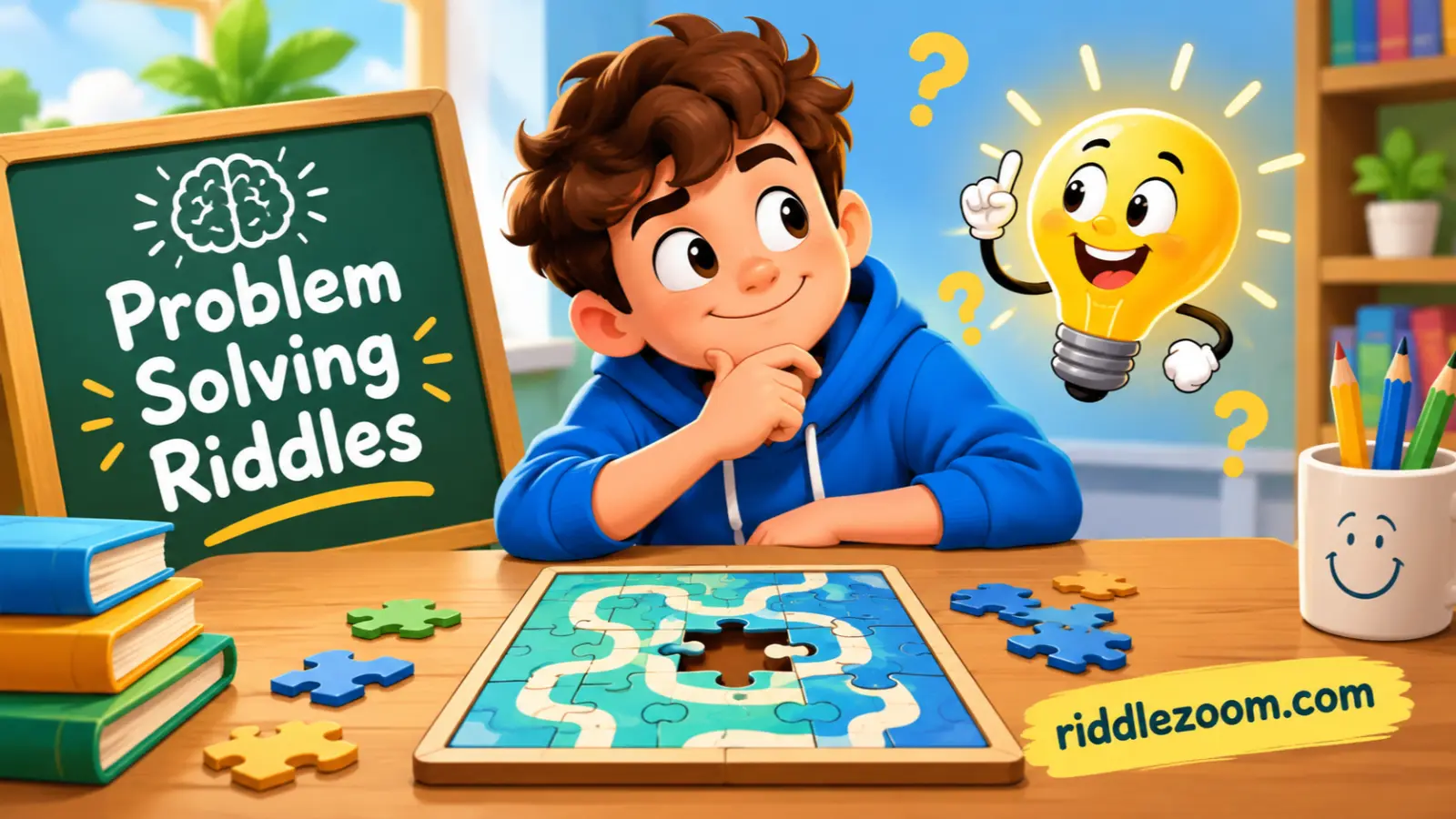
Problem solving is like walking through a mysterious garden: every path holds a question, every shadow hides a clue, and every turn offers a chance to discover something new.
Sometimes the answer is waiting in plain sight. Other times, it takes patience, imagination, and a willingness to look at a familiar situation from an entirely different angle. That is where problem solving riddles become so much fun.
These clever puzzles challenge you to connect clues, recognize patterns, test possibilities, and think beyond the obvious.
Some are simple enough to enjoy during a family game night, while others may leave even the sharpest minds wondering where they missed the trick.
Whether you are a curious kid, a puzzle-loving teen, or an adult who enjoys a meaningful mental challenge, there is something here for you.
On this page, you will find riddles involving everyday objects, logical situations, numbers, words, nature, mysteries, and creative thinking.
Each puzzle comes with an answer so you can check your reasoning and learn a new way to approach a problem.
Did You Know?
- Riddles encourage flexible thinking. A puzzle can have you abandon your first interpretation and consider a different one. This practice can help you approach everyday challenges with greater openness.
- Puzzles have a long history. Riddles appear in ancient literature from many cultures, including the famous riddle contests found in traditional stories. People have enjoyed testing their wits through questions and wordplay for centuries.
🎯 Riddle of the Day:
I guard a treasure you cannot touch,
Yet one small question can reveal so much.
I have no lock, no handle, no wall,
But solve what I hide, and I open for all.
Can you solve it? Share your guess in the comments before reading the riddles below!
Easy Problem Solving Riddles for Beginners
These beginner-friendly riddles help you practise observation, simple logic, and careful thinking without making the challenge too difficult.
- Riddle 1: I have a face but never smile,
I help you measure every mile.
What am I?Answer: A speedometer - Riddle 2: You see me when the daylight shines,
I copy your movements and follow your lines.
What am I?Answer: A shadow - Riddle 3: I have many teeth but cannot chew,
I straighten tangled hair for you.
What am I?Answer: A comb - Riddle 4: I grow shorter as I work,
Yet I help you see when nights are dark.
What am I?Answer: A candle - Riddle 5: I have hands but cannot clap,
I help you plan each daily task.
What am I?Answer: A clock - Riddle 6: I have pages but cannot speak,
Inside my covers, adventures you seek.
What am I?Answer: A book - Riddle 7: I can hold water but have many holes,
I help clean dishes, pots, and bowls.
What am I?Answer: A sponge - Riddle 8: I travel around the world while staying in one corner,
I carry a message from one place to another.
What am I?Answer: A postage stamp - Riddle 9: I open my mouth but never eat,
I welcome visitors at the street.
What am I?Answer: A doorway - Riddle 10: I have a neck but no head,
I may hold juice beside your bread.
What am I?Answer: A bottle - Riddle 11: I have a ring but no finger,
My sound can travel and linger.
What am I?Answer: A telephone - Riddle 12: I help you climb but have no feet,
I have many steps in a row so neat.
What am I?Answer: A staircase - Riddle 13: I get wet while making things dry,
Beside the bathroom, I often lie.
What am I?Answer: A towel - Riddle 14: I have a tongue but cannot taste,
I keep your foot secure in place.
What am I?Answer: A shoe - Riddle 15: I have a head and a tail, but no body in between,
Flip me once and a new side is seen.
What am I?Answer: A coin
Logical Problem Solving Riddles
Use these puzzles to practise drawing conclusions from the clues you are given. Read each line carefully before deciding what makes sense.
- Riddle 1: A farmer has ten sheep in a field,
All but three leave before the evening meal.
How many remain?Answer: Three sheep - Riddle 2: Two fathers and two sons go fishing one day,
Each catches one fish along the way.
They bring home only three fish in all.
How can every person answer the call?Answer: There are three people: a grandfather, his son, and his grandson. - Riddle 3: A room has four corners, each with a cat,
Each cat sees three others sitting flat.
How many cats are in the room?Answer: Four cats - Riddle 4: You have one match and enter a dark room,
With a candle and a lamp waiting in gloom.
What do you light first?Answer: The match - Riddle 5: A bus driver travels down a street,
Passes three red lights and four people on their feet.
What colour are the driver’s eyes?Answer: The riddle does not provide enough information to know. - Riddle 6: A man looks at a photograph and says,
“I have no siblings,” in a thoughtful haze.
“That man’s father is my father’s son.” Who is shown?Answer: His son - Riddle 7: A basket holds five apples, fresh and bright,
Five children each take one during the night.
One apple remains inside the basket. How can that be?Answer: The last child takes the basket with the apple still inside. - Riddle 8: Three switches sit outside a closed room,
One controls a bulb hidden in the gloom.
You may enter the room only once. How can you find the switch?Answer: Turn on the first switch for a few minutes, turn it off, and turn on the second. Enter the room: a lit bulb means the second switch; an unlit warm bulb means the first; an unlit cold bulb means the third. - Riddle 9: A man walks through heavy rain,
His clothes are soaked, but his hair remains.
How is his head still dry?Answer: He is bald. - Riddle 10: You have six eggs in a carton,
You break two for a meal at dawn.
You cook those same two and eat them too.
How many eggs are left for you?Answer: Four eggs - Riddle 11: A doctor gives you three pills to take,
One every half hour for your health’s sake.
How long until all three are taken?Answer: One hour - Riddle 12: A person reaches a river with no bridge,
No boat, no ferry, and no nearby ridge.
The river is frozen solid. How do they cross?Answer: They walk across the ice, assuming it is safe and solid enough. - Riddle 13: You enter a race and pass the runner in second place,
What position do you now hold in the chase?Answer: Second place - Riddle 14: A farmer has seventeen sheep in his care,
All but nine wander elsewhere. How many remain there?Answer: Nine sheep - Riddle 15: A clock takes six seconds to strike six,
With equal gaps between each sound it ticks.
How long will it take to strike twelve?Answer: About 13.2 seconds, if the same 1.2-second interval separates consecutive strikes.
Tricky Problem Solving Riddles
These puzzles encourage you to question your assumptions. The trick is often hidden in the wording rather than in the situation itself.
- Riddle 1: What becomes larger the more you remove,
Leaving an empty space as you move?
What is it?Answer: A hole - Riddle 2: I can be cracked, made, told, and played,
Yet I am not a toy that can be weighed.
What am I?Answer: A joke - Riddle 3: The more you take, the more you leave behind,
Look at your path and the answer you’ll find.
What are they?Answer: Footsteps - Riddle 4: What has cities but no houses,
Rivers but no flowing water,
And forests without trees?Answer: A map - Riddle 5: I belong to you, but others use me more,
You hear me called across a room or door.
What am I?Answer: Your name - Riddle 6: I can be full without holding a thing,
And empty without losing anything.
What am I?Answer: A calendar day - Riddle 7: What can you hold in your right hand,
But never in your left, as you stand?Answer: Your left elbow - Riddle 8: What goes up but never comes down,
Even when you travel from town to town?Answer: Your age - Riddle 9: I have one eye but cannot see,
I help thread pass through carefully.
What am I?Answer: A sewing needle - Riddle 10: What has many keys but no locks,
Can make music but never talks?Answer: A piano - Riddle 11: I can fill a room but take up no space,
I can vanish without leaving a trace.
What am I?Answer: Light - Riddle 12: What runs but never walks,
Has a bed but never sleeps,
And has a mouth without words?Answer: A river - Riddle 13: I am always ahead, yet never arrive,
People plan for me to keep dreams alive.
What am I?Answer: Tomorrow - Riddle 14: What has branches but no leaves,
And keeps money safe from thieves?Answer: A bank - Riddle 15: What can travel through glass without breaking it,
Yet disappears when darkness takes its place?Answer: A beam of light
Mathematical Problem Solving Riddles
Numbers are excellent puzzle partners. These riddles combine arithmetic, patterns, and careful interpretation to test your numerical reasoning.
- Riddle 1: I am an odd number, standing alone,
Remove one letter and an even number is shown.
What number am I?Answer: Seven - Riddle 2: Two numbers add up to ten,
Their difference is two. Find them again.Answer: Six and four - Riddle 3: I am a number between one and ten,
Multiply me by three and add one.
The result is sixteen. What number am I?Answer: Five - Riddle 4: Three friends share twelve sweets with care,
Each receives the same amount to share.
How many sweets does each friend get?Answer: Four sweets - Riddle 5: A dozen eggs sit in a tray,
Half are used to bake today.
How many remain for tomorrow’s treat?Answer: Six eggs - Riddle 6: A number doubles, then gains six,
The final total is twenty. What number fits?Answer: Seven - Riddle 7: Add five to twice a number,
And eighteen is what you discover.
What is the number?Answer: Six and a half - Riddle 8: I have four equal sides,
My corners are right angles inside.
What shape am I?Answer: A square - Riddle 9: A farmer counts four legs on each of five sheep,
How many sheep legs altogether can he keep?Answer: Twenty legs - Riddle 10: A pattern goes two, four, eight, sixteen,
What number comes next in this doubling scene?Answer: Thirty-two - Riddle 11: I am the smallest positive number,
Divisible by two, three, and four without remainder.
What am I?Answer: Twelve - Riddle 12: A rectangle measures eight units long,
And three units wide. Find its area before long.Answer: Twenty-four square units - Riddle 13: A baker sells half of twenty cakes,
Then sells two more for customers’ sakes.
How many cakes remain?Answer: Eight cakes - Riddle 14: I am a two-digit number,
My digits total nine.
Reverse me and I become twenty-seven less.
What number am I?Answer: 63 - Riddle 15: Four workers finish a job in six days,
If productivity stays constant, how many worker-days does it take?Answer: Twenty-four worker-days
Everyday Life Problem Solving Riddles
Ordinary objects and familiar situations can hide surprisingly clever puzzles. Look for what each object actually does instead of what its name suggests.
- Riddle 1: I keep your food cool in the heat,
I hum in the kitchen but never eat.
What am I?Answer: A refrigerator - Riddle 2: I open with a turn but have no hands,
I keep strangers out of your lands.
What am I?Answer: A key - Riddle 3: I swallow dirty clothes and spin them around,
Then send them out clean without a sound.
What am I?Answer: A washing machine - Riddle 4: I show your face but have no eyes,
I copy your movements without surprise.
What am I?Answer: A mirror - Riddle 5: I hold your head while you sleep,
On a soft bed, my place I keep.
What am I?Answer: A pillow - Riddle 6: I keep rain away from your hair,
I open above you when storms appear.
What am I?Answer: An umbrella - Riddle 7: I have a handle but cannot open a door,
I help sweep dirt across the floor.
What am I?Answer: A broom - Riddle 8: I have a screen but no window view,
I show you films, games, and news.
What am I?Answer: A television - Riddle 9: I help you reach a distant friend,
With messages and calls that never need a pen.
What am I?Answer: A smartphone - Riddle 10: I make a room bright at the push of a switch,
Without me, reading can be a hitch.
What am I?Answer: An electric lamp - Riddle 11: I hold your drink but never sip,
I sit in your hand on every trip.
What am I?Answer: A travel mug - Riddle 12: I keep your pages in a neat row,
Turn me to find what you want to know.
What am I?Answer: A notebook - Riddle 13: I cut through paper with two sharp sides,
My handles help where the cutting hides.
What am I?Answer: Scissors - Riddle 14: I tell you when your clothes are too hot,
I spin them dry inside my spot.
What am I?Answer: A tumble dryer - Riddle 15: I help you reach the top shelf high,
I fold away when not nearby.
What am I?Answer: A step stool
Lateral Thinking Riddles for Creative Minds
Lateral thinking means exploring possibilities that may not be obvious at first. These riddles invite you to look at a problem from an unexpected angle.
- Riddle 1: A man pushes his car to a hotel,
Then tells the owner he has lost it all.
Why?Answer: He is playing Monopoly. - Riddle 2: A woman leaves home, turns left three times,
And returns to find two masked figures in line.
What is happening?Answer: She is playing baseball and returns to home plate; the masked figures are the catcher and umpire. - Riddle 3: A person falls from a tall ladder,
Yet suffers no injury that matters.
How?Answer: They fall from the bottom rung. - Riddle 4: A man walks into a room and sees water on the floor,
Broken glass nearby and a fish no more.
What happened?Answer: A fishbowl fell and broke. - Riddle 5: A person shaves several times each day,
Yet keeps a beard that will not go away.
How?Answer: They are a barber who shaves other people. - Riddle 6: A woman looks at a clock with no hands,
Yet knows when the evening begins. How?Answer: She uses another time cue, such as a spoken announcement or a scheduled event. - Riddle 7: A man walks into a restaurant and asks for water,
The waiter points a finger. The man says, “Thank you,” and leaves. Why?Answer: The waiter startled him out of a hiccup. - Riddle 8: A person enters a dark house without a torch,
Finds everything clearly by the porch. How?Answer: It is daytime, and sunlight enters through the windows. - Riddle 9: A traveller arrives in a town on Monday,
Stays two days, then leaves on Monday. How?Answer: Monday is the name of the traveller’s horse. - Riddle 10: A boy throws a ball as hard as he can,
It returns without touching a wall or a man. How?Answer: He throws it straight up into the air. - Riddle 11: A woman is surrounded by water,
Yet she never gets wet. How can that be?Answer: She is standing on a map or looking at a picture of water. - Riddle 12: A person writes a letter without a pen,
Sends it instantly and writes again. How?Answer: They type an electronic message. - Riddle 13: A man stands outside in freezing weather,
But his shadow never appears beside him. Why?Answer: It is nighttime, with no light source casting a visible shadow. - Riddle 14: A woman opens an empty box and finds a gift,
No object inside, yet spirits lift. What is it?Answer: A promise or invitation written on the box lid. - Riddle 15: A person arrives first but finishes last,
Yet wins the contest when the test has passed. How?Answer: The contest rewards the slowest finish rather than the fastest.
Problem Solving Riddles for Kids
These cheerful puzzles give younger readers a chance to practise reasoning while enjoying familiar things from school, home, and playtime.
- Riddle 1: I am round and bounce when thrown,
In playground games, I’m widely known.
What am I?Answer: A basketball - Riddle 2: I have colourful pages and pictures to see,
I help you learn your ABCs.
What am I?Answer: An alphabet book - Riddle 3: I have a shell but am not a nut,
I move very slowly and tuck my head shut.
What am I?Answer: A turtle - Riddle 4: I fall from the sky but never climb,
I help flowers grow over time.
What am I?Answer: Rain - Riddle 5: I have wheels but no feet,
I carry your toys along the street.
What am I?Answer: A toy wagon - Riddle 6: I wear a crown but am not a king,
I grow in a garden and make summer sing.
What am I?Answer: A sunflower - Riddle 7: I have stripes but am not a shirt,
I gallop across the grass and dirt.
What am I?Answer: A zebra - Riddle 8: I can fly without feathers,
Children hold my string in windy weather.
What am I?Answer: A kite - Riddle 9: I am full of colours after rain,
A beautiful arc appears again.
What am I?Answer: A rainbow - Riddle 10: I have a trunk but no suitcase,
I stand tall in a leafy place.
What am I?Answer: An elephant - Riddle 11: I am made of snow and have a carrot nose,
I melt when warm weather grows.
What am I?Answer: A snowman - Riddle 12: I have a cap but no head,
I help you write words on paper instead.
What am I?Answer: A marker pen - Riddle 13: I hop around and have long ears,
I nibble carrots and disappear.
What am I?Answer: A rabbit - Riddle 14: I have a door and tiny rooms,
A favourite toy lives where imagination blooms.
What am I?Answer: A dollhouse - Riddle 15: I am small and bright and appear at night,
I twinkle above you, far out of sight.
What am I?Answer: A star
Nature-Based Problem Solving Riddles
Nature offers patterns, cycles, and fascinating details. Use the clues in each riddle to identify the natural feature being described.
- Riddle 1: I wear green in summer and gold in fall,
My branches stretch high and tall.
What am I?Answer: A deciduous tree - Riddle 2: I travel from mountain to sea,
Carrying water naturally.
What am I?Answer: A stream - Riddle 3: I appear after the rain has passed,
Yet I cannot be held and never last.
What am I?Answer: A rainbow - Riddle 4: I shine by day but am not a flame,
I warm the world without a name.
What am I?Answer: The Sun - Riddle 5: I change my shape throughout the month,
Sometimes thin, sometimes round as a bun.
What am I?Answer: The Moon - Riddle 6: I have no feet but cross the sky,
I carry rain as I drift on high.
What am I?Answer: A cloud - Riddle 7: I roar without a mouth,
My water tumbles from great heights down south.
What am I?Answer: A waterfall - Riddle 8: I hide beneath the earth for years,
Then rise with colour when spring appears.
What am I?Answer: A flower bulb - Riddle 9: I am a blanket spread across the ground,
I sparkle in the morning without a sound.
What am I?Answer: Dew - Riddle 10: I have no voice but whistle through trees,
I move the leaves with an invisible breeze.
What am I?Answer: Wind - Riddle 11: I form in the cold on windows at night,
My delicate patterns glitter white.
What am I?Answer: Frost - Riddle 12: I rumble in clouds and follow a flash,
My sudden sound can make windows clash.
What am I?Answer: Thunder - Riddle 13: I lie beneath waves, unseen from shore,
I hold strange creatures and much more.
What am I?Answer: The ocean floor - Riddle 14: I am a rocky tower shaped by time,
I rise from the earth in a rugged climb.
What am I?Answer: A mountain peak - Riddle 15: I turn a tiny seed into a plant,
I provide the energy every leaf will want.
What am I?Answer: Sunlight
Animal Riddles That Test Observation
Animals have distinctive habits and features. These riddles ask you to notice the clues rather than guess at random.
- Riddle 1: I carry my home wherever I go,
My pace is gentle, my journey slow.
What am I?Answer: A snail - Riddle 2: I have eight legs and spin a web,
I catch my food without a net.
What am I?Answer: A spider - Riddle 3: I sleep upside down in a cave,
At dusk I fly out, swift and brave.
What am I?Answer: A bat - Riddle 4: I am a bird that cannot fly,
I waddle along beneath the sky.
What am I?Answer: A penguin - Riddle 5: I have a pouch where my baby can stay,
I hop across Australia by day.
What am I?Answer: A kangaroo - Riddle 6: I change my colours to blend with the scene,
I hide from danger in shades of green.
What am I?Answer: A chameleon - Riddle 7: I build a dam with sticks and mud,
I swim through rivers and splash through the flood.
What am I?Answer: A beaver - Riddle 8: I have a long neck and spotted coat,
I reach tall branches without a boat.
What am I?Answer: A giraffe - Riddle 9: I am a big cat with a striped design,
I stalk through forests and rest in sunshine.
What am I?Answer: A tiger - Riddle 10: I am known for my black-and-white suit,
I munch on bamboo, a favourite pursuit.
What am I?Answer: A giant panda - Riddle 11: I carry a shell on my back,
I crawl across the land without a track.
What am I?Answer: A tortoise - Riddle 12: I buzz from flower to flower,
I help plants grow with pollinating power.
What am I?Answer: A honeybee - Riddle 13: I have a mane and a mighty roar,
I am called the king, though I wear no crown.
What am I?Answer: A lion - Riddle 14: I live in water and breathe through gills,
I swim past rocks and underwater hills.
What am I?Answer: A trout - Riddle 15: I am clever, red, and have a bushy tail,
I sneak through the woods on a quiet trail.
What am I?Answer: A fox
Wordplay Problem Solving Riddles
Words can have more than one meaning, and their sounds or spelling can hide unexpected clues. These riddles reward careful reading and a little imagination.
- Riddle 1: What word becomes shorter when you add two letters to it?Answer: Short
- Riddle 2: I begin with T, end with T, and have T inside,
Open me up and your drink can hide. What am I?Answer: A teapot - Riddle 3: What word contains three consecutive double letters?Answer: Bookkeeper
- Riddle 4: I am found once in a minute,
Twice in a moment, but never in a thousand years. What am I?Answer: The letter M - Riddle 5: What begins with E, ends with E,
And contains only one letter?Answer: An envelope - Riddle 6: What five-letter word sounds the same when four letters are removed?Answer: Queue
- Riddle 7: I can be spoken, written, or broken,
Yet I am not a toy or token. What am I?Answer: A promise - Riddle 8: What has four letters, sometimes has nine,
But never has five and always has six?Answer: These are statements, not a numerical puzzle: “what” has four letters, “sometimes” has nine, “never” has five, and “always” has six. - Riddle 9: What word starts with P, ends with E,
And contains thousands of letters inside?Answer: A post office - Riddle 10: What word has a thousand letters but is not a long word?Answer: A letter collection, such as a stack of mail
- Riddle 11: What can you catch but cannot throw,
And can spread from person to person?Answer: A cold - Riddle 12: What word is pronounced the same if you take away its first, last, and middle letter?Answer: A riddle has no single standard answer to this wording; it depends on the word and pronunciation chosen.
- Riddle 13: What starts with an “e,” ends with an “e,” and is full of water?Answer: An ewer
- Riddle 14: What has a head, a foot, and four legs,
Yet cannot walk or dance at parties?Answer: A bed - Riddle 15: I can be right but never left,
I can be wrong but still be said. What am I?Answer: An answer
Difficult Problem Solving Riddles for Adults
These challenges involve multiple clues, unusual interpretations, and a little patience. Work through the wording before looking at the answers.
- Riddle 1: A person has two ropes, each taking exactly one hour to burn,
But they burn unevenly at every turn.
How can they measure forty-five minutes?Answer: Light the first rope at both ends and the second rope at one end. When the first rope finishes after 30 minutes, light the other end of the second rope. It then finishes in 15 more minutes, measuring 45 minutes total. - Riddle 2: You have three boxes labelled apples, oranges, and mixed,
Every label is wrong. You may take one fruit from one box.
How can you label all three correctly?Answer: Take a fruit from the box labelled “mixed.” Since that label is wrong, the box contains only one fruit type. Use the fruit drawn to identify it, then deduce the other two boxes because all labels are incorrect. - Riddle 3: A prisoner faces two doors, one safe and one dangerous,
Two guards stand nearby, one truthful and one lying.
You may ask one question to one guard. What do you ask?Answer: Ask either guard, “Which door would the other guard say is safe?” Then choose the opposite door. - Riddle 4: A man must carry a fox, a chicken, and grain across a river,
His boat carries only him and one item.
How can he transport all three safely?Answer: Take the chicken across, return alone, take the fox across, bring the chicken back, take the grain across, return alone, then take the chicken across again. - Riddle 5: You have eight identical-looking balls,
One is heavier, and a balance scale is all.
How can you find it in two weighings?Answer: Weigh three balls against three. If balanced, weigh the remaining two against each other. If unbalanced, weigh two balls from the heavier group against each other; if they balance, the third is heavier. - Riddle 6: A room contains three lamps and three switches,
Each switch controls one lamp in the room next door.
How can you identify all three with one visit?Answer: Turn on the first switch for several minutes, then turn it off. Turn on the second and enter the room. The lit lamp belongs to the second switch; the warm, unlit lamp to the first; the cold, unlit lamp to the third. - Riddle 7: A clock loses five minutes every hour,
It is set correctly at noon.
What will it show when the real time is 6 p.m.?Answer: 5:30 p.m., if the clock loses five minutes for every real hour elapsed. - Riddle 8: A person must cross a bridge at night,
Four people need different times: one, two, seven, and ten minutes.
Only two can cross at once, and they need one torch. What is the minimum time?Answer: Seventeen minutes: the one- and two-minute walkers cross, the one-minute walker returns, the seven- and ten-minute walkers cross, the two-minute walker returns, then the one- and two-minute walkers cross again. - Riddle 9: A number multiplied by itself gives 49,
But it is not always the same sign.
What numbers can it be?Answer: Seven and negative seven - Riddle 10: You have a five-litre jug and a three-litre jug,
Neither has measuring marks.
How can you measure exactly four litres?Answer: Fill the five-litre jug and pour into the three-litre jug, leaving two litres. Empty the three-litre jug and transfer the two litres into it. Fill the five-litre jug again, then pour one litre into the three-litre jug to fill it. Three litres remain in the five-litre jug, so this sequence needs adjustment for four litres: fill the five-litre jug, pour into the three-litre jug, leaving two litres; empty the three-litre jug and transfer the two litres into it; refill the five-litre jug and pour into the three-litre jug until full, leaving four litres in the five-litre jug. - Riddle 11: A room has no windows and no doors,
Inside is a golden treasure no one stores.
What is it?Answer: An egg - Riddle 12: A number has two digits.
Its digits add to twelve, and reversing them makes it eighteen smaller.
What is the number?Answer: 75 - Riddle 13: You have nine identical coins,
One is lighter, and a balance scale is available.
What is the fewest weighings needed to find it?Answer: Two weighings. Divide the coins into groups of three, weigh two groups, then weigh two coins from the suspect group of three. - Riddle 14: A farmer needs to divide a square field into four equal parts,
He may draw only two straight lines.
How can he do it?Answer: Draw two perpendicular lines through the centre of the square. - Riddle 15: A person sees a number and says,
“Double it, add ten, halve it, then subtract the original number.”
What is the result for any starting number?Answer: Five
Mystery and Detective Problem Solving Riddles
Detective riddles require you to compare statements, identify inconsistencies, and separate what is known from what is merely assumed.
- Riddle 1: A valuable painting disappears from a gallery,
Three visitors say they saw nothing.
One visitor was standing in a room that was completely dark. What clue matters?Answer: The claim of seeing nothing in a dark room is not necessarily suspicious; without more evidence, the statements alone do not identify a thief. - Riddle 2: A detective finds muddy footprints leading into a house,
But none lead back out.
What could explain this?Answer: The person may have left by another exit or the footprints may have been cleaned or obscured. - Riddle 3: A locked office has a wet floor,
A closed window, and a puddle beside the desk.
What might have happened?Answer: A container of water may have spilled. The clues do not prove a single cause. - Riddle 4: A witness says the streetlight was shining,
Another says the whole street was dark.
Can both be correct?Answer: Yes. One streetlight may have been working while the rest of the street was dark. - Riddle 5: A detective finds a broken clock stopped at 8:15,
Can that alone prove when the crime happened?Answer: No. The clock may have stopped earlier or later than the event. - Riddle 6: A door is locked from the inside,
No one is found in the room.
What should a detective check first?Answer: Possible exits, adjoining spaces, and whether the lock can be manipulated from outside. - Riddle 7: A note reads, “The answer is under the table,”
But nothing is there.
What else could “under” mean?Answer: It could refer to a table of data, a heading, or another context rather than a physical table. - Riddle 8: Three people give three different accounts,
Two agree on one detail, but both could be mistaken.
What is the safest conclusion?Answer: Agreement alone does not establish truth; seek independent evidence. - Riddle 9: A glass is full, but the table beneath it is dry,
A second glass has vanished nearby. Why might that be?Answer: Someone may have moved the second glass; the first glass being full does not explain the disappearance. - Riddle 10: A suspect says they were home all evening,
A neighbour saw their porch light turn on at nine.
Does this prove the suspect was home?Answer: No. A porch light can be switched on remotely or by a timer. - Riddle 11: A detective sees snow outside and wet shoes inside,
Yet the hallway floor is dry.
How could that happen?Answer: The shoes may have been wiped, dried, or changed before entering the hallway. - Riddle 12: A missing book is found on a shelf,
But its bookmark has moved.
What can the detective conclude?Answer: Someone may have handled the book, but the bookmark alone cannot identify who. - Riddle 13: A window is open after a storm,
The curtains are dry, and the floor is wet.
What is one possible explanation?Answer: Water may have entered through another opening or been spilled inside. - Riddle 14: A witness remembers a blue car,
But a photograph shows a dark vehicle.
What should be checked?Answer: Lighting, image quality, the witness’s viewing conditions, and whether the photograph shows the same vehicle. - Riddle 15: A detective finds a clue that supports two theories,
How should the investigation proceed?Answer: Gather more independent evidence and test both theories rather than choosing one prematurely.
Advanced Creative Problem Solving Riddles
The final set combines patterns, practical reasoning, and creative approaches. Some have precise solutions; others test whether you can recognise the limits of the information provided.
- Riddle 1: You have a sheet of paper and a pair of scissors,
How can you make a hole large enough for your body to pass through?Answer: Fold the paper and cut a continuous loop pattern around alternating folds, creating a large ring of connected paper. - Riddle 2: You need to transport water without a bucket,
You have ice, a cloth, and a bottle. What can you do?Answer: Melt the ice inside the bottle to collect water. - Riddle 3: A room grows brighter when a wall is removed,
Yet no lamp is added. How?Answer: Removing the wall allows more natural light to enter. - Riddle 4: You must cross a room without touching the floor,
There is a chair, a desk, and a door. How?Answer: Step across the chair and desk, if they are safely positioned and can support your weight. - Riddle 5: A plant is growing toward a window,
Though no one tells it where to go. Why?Answer: It responds to light through phototropism. - Riddle 6: You need to remember a list of ten items,
But writing them down is not allowed.
What technique can help?Answer: Create a memorable story or group the items into meaningful categories. - Riddle 7: You have a candle, a mirror, and a sunny window,
How can you light a dark corner without electricity?Answer: Use the mirror to reflect sunlight into the corner, assuming the sun is shining at a suitable angle. - Riddle 8: A paper plane flies farther when you change one thing,
But the room, thrower, and paper stay the same.
What might you change?Answer: Adjust the plane’s fold, weight distribution, or wing shape. - Riddle 9: You have a pile of mixed puzzle pieces,
No picture, no guide, and no box.
What is a sensible first step?Answer: Sort pieces by colour, edge shape, and distinctive patterns. - Riddle 10: A team cannot agree on one solution,
Every person has a different idea.
What method can help them move forward?Answer: List the options, compare them against shared criteria, and test the strongest candidates. - Riddle 11: You have a long queue and little time,
How could you reduce the wait without moving anyone out of line?Answer: Open additional service points if possible, or prepare people and materials in advance to speed up processing. - Riddle 12: A machine works well in the morning,
But fails repeatedly in the afternoon.
What should you investigate first?Answer: Look for conditions that change during the day, such as heat, load, power supply, or operator routines. - Riddle 13: You need to find a missing object in a cluttered room,
But searching randomly takes too long.
What is a better method?Answer: Search systematically by dividing the room into sections and checking each area once. - Riddle 14: A plan seems perfect on paper,
But fails when put into practice.
What should you do next?Answer: Identify the assumptions behind the plan, test them, and revise the approach using what you learn. - Riddle 15: A problem seems impossible because every path appears blocked,
What question might help you discover another way?Answer: Ask, “Which assumption am I treating as a rule, even though it may not be necessary?”
FAQs:
1. What are problem solving riddles?
Problem solving riddles are puzzles that require you to interpret clues, recognise patterns, use logic, or consider creative alternatives to reach an answer. They range from simple word puzzles to multi-step challenges.
2. How do problem solving riddles improve thinking skills?
They encourage careful reading, logical reasoning, pattern recognition, and flexible thinking. They can also provide practice in explaining why an answer makes sense, rather than guessing without evidence.
3. Are problem solving riddles suitable for kids?
Yes. Age-appropriate riddles can help children practise observation, vocabulary, number skills, and reasoning in an enjoyable way. Younger children may benefit from hints and opportunities to talk through their ideas.
4. What is the best way to solve a difficult riddle?
Read the wording slowly, identify the important clues, and avoid assuming that the first interpretation is correct. Try alternative explanations, eliminate answers that contradict the clues, and check your final solution against the entire riddle.
5. Can adults benefit from solving riddles?
Absolutely. Adults can use riddles as a light mental exercise, a social activity, or a way to practise approaching familiar problems from new perspectives. The greatest benefit often comes from discussing the reasoning behind each answer.
Conclusion:
Problem solving riddles remind us that a challenge does not always require a complicated solution. Sometimes the key is a small detail, a clever pattern, or a question we forgot to ask.
From easy everyday puzzles to difficult logic challenges, each riddle offers an opportunity to pause, observe, and explore a fresh perspective.
Whether you solved every puzzle quickly or needed a little help along the way, the important thing is to enjoy the process.
Getting an answer wrong is not a failure; it is a chance to reconsider the clues and discover a better approach.
Share these riddles with kids, teens, friends, or family members and see how differently everyone thinks.

Hi, I’m Justin Rick, the creator behind RiddleZoom.com, where curiosity meets creativity and every riddle is a new adventure!
I’m passionate about words, clever puzzles, and the joy of solving a good riddle. My goal is to make thinking fun by sharing entertaining, tricky, funny, and brain-teasing riddles for readers of all ages.
Whether you’re looking for a quick laugh, a clever challenge, or a fun way to test your brain, you’re in the right place.
Think sharp, stay curious, and let the riddles begin!
1 thought on “195+ Problem Solving Riddles Fun Puzzles to Test Your Skills”